Stop Letting a Silent Website Cost You Sales
Your website might look good, but if it is not bringing in qualified leads you can track, it is costing you money every single day. Many small businesses across Canada end up with a nice-looking brochure site that quietly sits there instead of acting like a real salesperson.
Here is what we see all the time with small business marketing:
- Random SEO and ad experiments with no clear plan
- No follow-up system, so leads go cold
- Slow response to form fills and missed calls
- No simple way to see which marketing actually brings in good leads
The real problem is not your homepage colours. It is that your website is not plugged into a connected marketing system. When your site, SEO, ads, and CRM work together, your website starts to act like your best salesperson, working 24/7, tracking results, and fitting your real-world sales process. We call this the Invisible Sales Funnel, and in this article, we will walk through how to build it as a lead generation system for small businesses.
The Invisible Sales Funnel: What a Selling Website Really Does
A selling website has one job broken into four parts. It should:
- Attract the right people
- Prove you can solve their problem
- Get them to raise their hand
- Start a real sales conversation
That is it. Every page, button, and form should support one of those four jobs.
For a small business, this is what a full lead generation system looks like from first click to booked call, email, or visit. Someone searches on Google, sees an ad, or hears about you. They land on a page that clearly explains what you do and who it is for. They see proof that you get results. Then they are invited to take the next step that fits them: call now, book a time, or request a quick call-back.
Compare that to a typical "pretty" site:
- Vague headlines that could fit any business
- One tiny "Contact" link buried in the menu
- No reviews or proof that you actually deliver
- No follow-up if someone does enquire
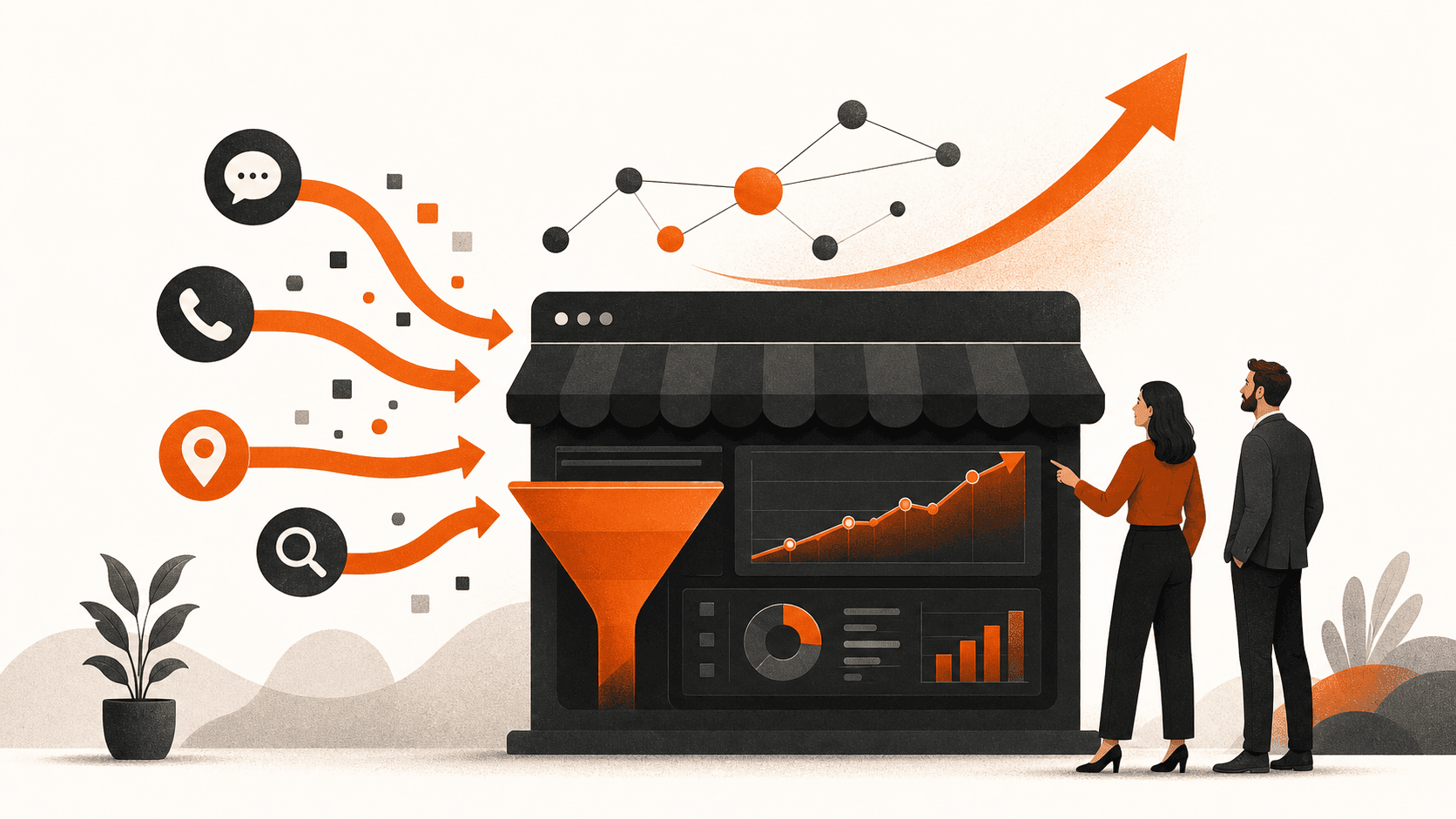
The Invisible Sales Funnel fixes this. It starts with a selling site, then is fed by a simple engine we call the Three-Channel Marketing System: SEO, local ads, and follow-up. Those three channels keep sending the right people into your funnel, day after day.
Build a Three-Channel Marketing System Around Your Site
Marketing should be a system, not a gamble. If you rely on one channel, or one random campaign, results rise and fall and you never feel in control. A Three-Channel Marketing System spreads your bets but keeps everything working together.
Channel 1 is search and local SEO. You want to rise up the ranks when people in your area look for what you do. That means:
- Clear service pages focused on each main service
- Local keywords that match what people actually type
- A complete Google Business Profile
- A steady flow of real customer reviews
Channel 2 is paid traffic you can turn up or down. That might be Google Ads or social ads. The key is to send people to focused landing pages on your website, not your home page. Each campaign should match one clear offer on one page.
Channel 3 is follow-up. Most visitors are not ready to buy right away. Email, SMS, and retargeting ads bring back people who visited or enquired but were not ready yet. Together, these three channels feed your site and, when they are tracked properly, you can finally see which channel brings the best leads, not just the most clicks.
Turn Visitors Into Real Leads on Your Website
Most small business websites fail at lead capture. They either ask for too much too soon or they hide the next step so visitors have to hunt for it.
A strong selling site always offers three main "next steps":
- Call now
- Book a time
- Leave details for a fast call-back
You can place "Call now" buttons at the top of every page, especially on mobile. Online booking or a simple calendar link can sit in the middle of key pages. A short form for a fast call-back can sit near the bottom for people who want low-effort.
Speed to lead matters a lot. Leads contacted within the first few minutes are far more likely to turn into real conversations. If your team waits until the end of the day to follow up, you are giving that lead to a faster competitor.
To make your pages convincing, add proof elements like:
- Before and after stories in plain language
- Simple numbers that show improvement or results
- Reviews with first names and locations
- Photos or short videos of real work
- Short FAQs that answer the top 5 questions
Every missed call is a missed opportunity. Your site should make it easy to enquire after hours too, with forms and booking links that clearly state when someone will get a response.
Connect Your Website to Your CRM so Nothing Slips
This is where CedarCRM comes in. A CRM is a single place where every lead from your website, ads, and calls can land, get tagged, and move through simple stages like new lead, contacted, quoted, won, or lost.
With CedarCRM connected to your site, this starts to happen automatically:
- New web leads get an instant text reply so they know you got their message
- Simple email sequences go out to people who are still deciding
- Your team gets reminders so no one forgets to call back
Speed to lead improves again when CedarCRM alerts you within seconds when a form is filled or a call is missed. Someone on your team can follow up while the person is still thinking about you.
Because everything is in one place, you also see which pages and campaigns bring in leads that actually turn into revenue, not just traffic. That is when your website becomes a real lead generation system for small businesses, not a guessing game.
Put It All Into a 90-day Growth Plan
Trying to fix everything at once almost always fails, especially for small teams. A focused 90-day Growth Plan gives you wins every month without overwhelming you.
Here is a simple version of that plan:
- Days 1 to 30, fix the basics on your website
- Clarify your main offer and who it is for
- Add strong calls to action for calling, booking, and call-backs
- Improve mobile speed and readability
- Turn on basic tracking so you can see form fills and calls
- Days 31 to 60, set up the Three-Channel Marketing System
- Update your local SEO, service pages, and Google Business Profile
- Launch one or two focused ad campaigns to dedicated landing pages
- Write basic follow-up emails and texts for new leads
- Days 61 to 90, connect everything in CedarCRM
- Plug your forms, calls, and ads into CedarCRM
- Tighten your phone and email scripts based on real conversations
- Cut the channels and pages that do not bring good leads
- Double down on the ones that result in actual sales
At this point, you have turned random marketing into a connected marketing system that you can measure and improve every month. Your website is no longer a lonely brochure. It is the centre of The Invisible Sales Funnel, fed by the Three-Channel Marketing System and tracked inside CedarCRM, working quietly in the background while you run your business.
Turn Your Website Traffic Into Reliable Revenue Growth
If you are ready to turn more browsers into booked calls and paying clients, we can help you put a proven system in place. At Curve Communications, we map out a tailored lead generation system for small businesses that fits your goals, budget, and capacity. Tell us a bit about your business and we will outline your next best steps, from messaging to automation. To get started, simply contact us and schedule a time to talk.